
PVC Control Joint (Roof Divider)
PVC Control Joint (Roof Divider)
Revision as of 20:00, 12 November 2025 by James Klassen (talk | contribs)
Division D - Construction Details
PVC | Control Joint (Roof Divider) ( Article 10.3.2.3.; Article 10.3.4.1.)
| Notice to Reader | |
| Images used in a Construction Detail are representative and not prescriptive, and are not necessarily drawn to scale. They are intended to support the related Standard (Ref. Division A, Article 2.2.1.2.).
The reader may link to the related Article in the detail title, or link to the Standard as it relates to a specific element in the detail. All hyperlinks are displayed blue text. | |
PVC Details
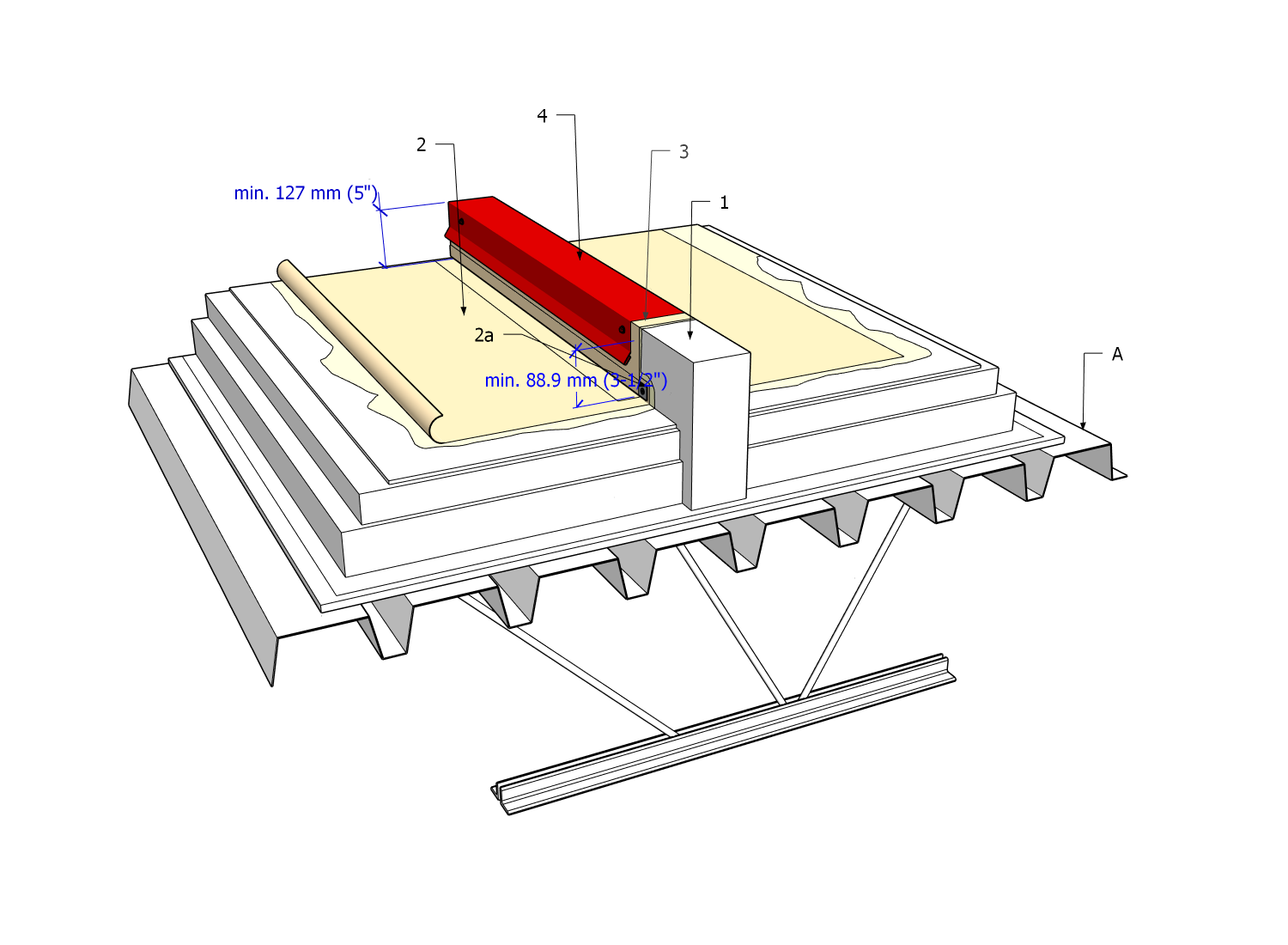
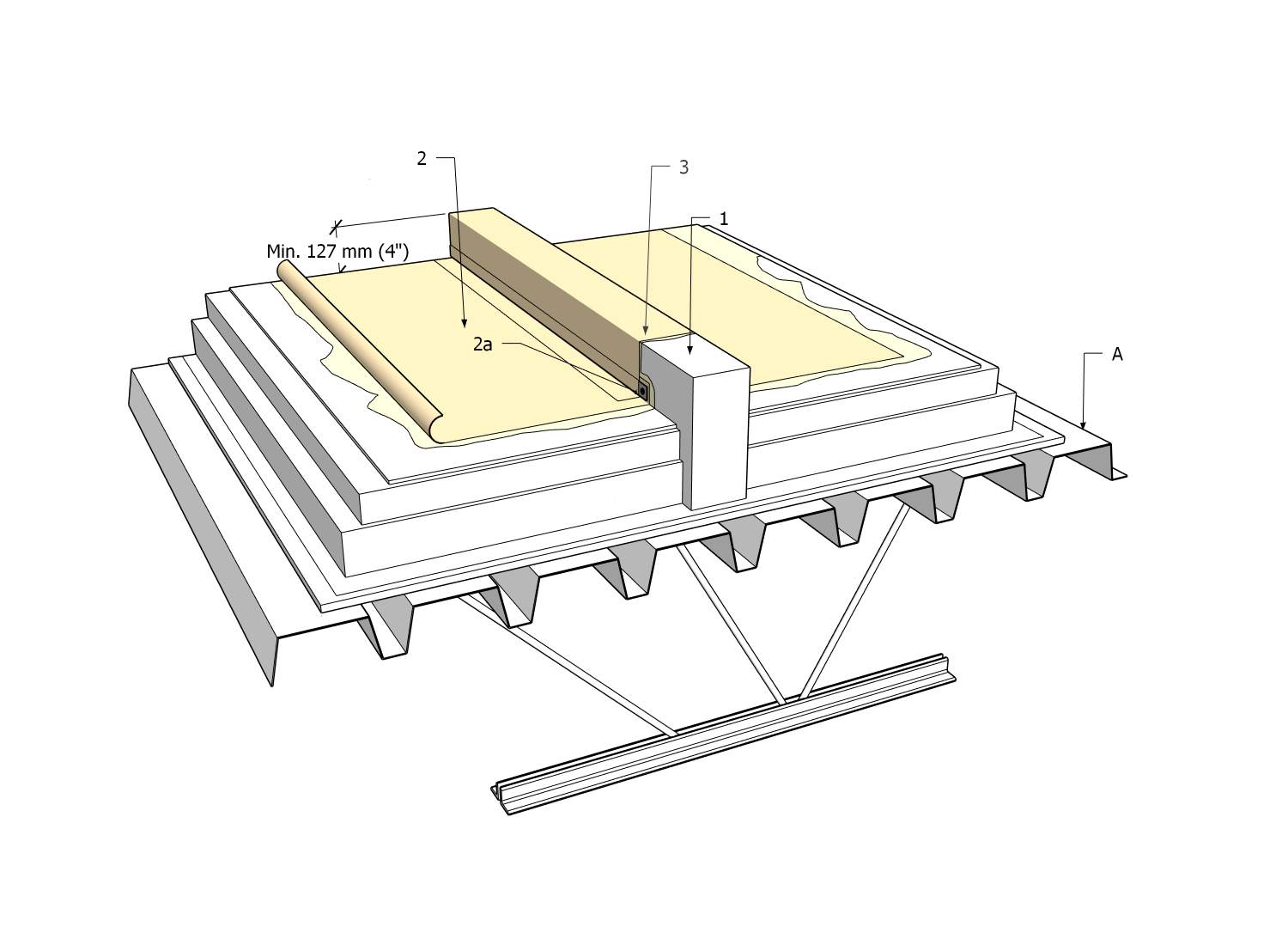


1 WORK INCLUDED
- (1) Control Joint (Roof Divider)
- Typically framed with dimensional lumber and plywood on site by the Contractor, or by others (as specified). See Article 10.1.6.2. concerning permissible design heights for control joints.
- Two models are illustrated here. A control joint may be as low as 101.6 mm (4”), shown in Drawing B, provided it is not capped with a linear metal flashing. If a metal cap flashing is specified, the minimum height of the control joint must be 127 mm (5”), shown in Drawing A, and screw fasteners securing the cap flashing must be kept at least 88.9 mm (3-1/2”) above the finished roof system surface.
- (2) Roof field membrane
- Installed as required in Part 9, adhered to the sides of the control joint, and mechanically secured to the vertical surface with a ‘term’ bar (illustrated).
- (2a) Roof Membrane Securement Strip
- Proprietary to a single-ply membrane manufacturer and installed to secure the field membrane at the base of a wall, parapet, expansion joint, or control joint. Not required for SBS-modified bituminous membrane systems.
- (3) Membrane flashing
- Covers (adhered to) the control joint and overlaps the field membrane.
- (4) Metal Cap Flashing
- Cap flashing must be designed and installed as required in Part 13.
- Note that the cap flashing is sloped at least 2% (mono slope illustrated) when the width of the flashing exceeds 101.6 mm (4”) (Ref. Article 13.1.3.6., “Cap Flashing, Counter-flashing, and Reglet Flashing”).
- Fasteners used to secure metal flashing must be at least 88.9 mm (3-1/2”) above the finished roof system surface.
2 RELATED WORK BY OTHERS
- (A) Acceptable deck
NOTE: See the Standard for additional requirements.
Back to PVC Roof System Details
© RCABC 2026
RoofStarTM is a registered Trademark of the RCABC.
No reproduction of this material, in whole or in part, is lawful without the expressed permission of the RCABC Guarantee Corp.